Discover the secret with the iLearn-Framework!
Learn. Practice. Apply. Does this sound familiar? This method is based on William Horton’s ‘Absorb Do Connect’ approach, which is primarily used in e-learning. However, in our rapidly changing society, more is needed to keep up.
That is why UQ developed the scientifically grounded iLearn-Framework©️, a blueprint for a unique learning experience. It consists of six essential steps that we briefly highlight below.
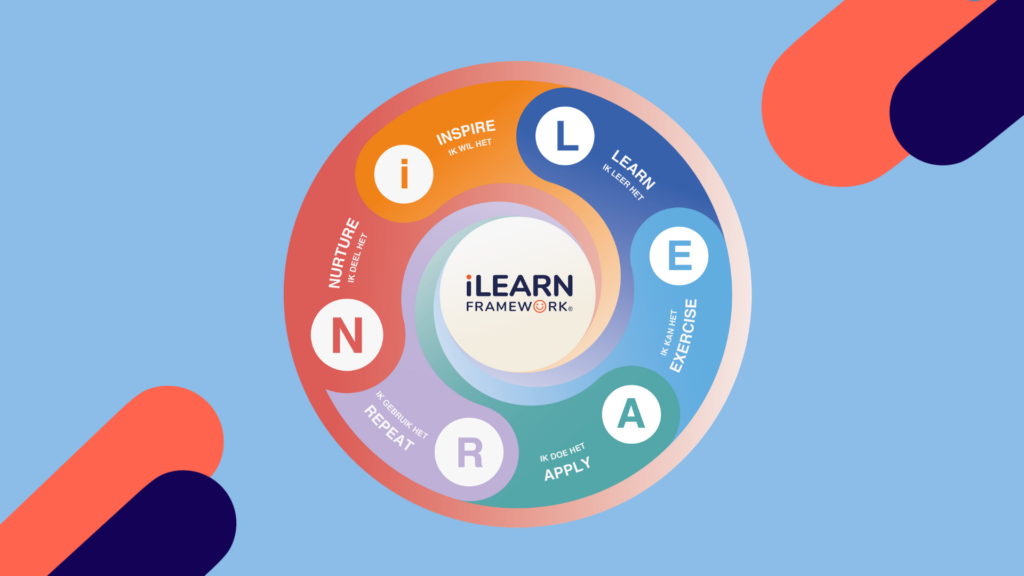
Inspire
Before actual learning begins, something must click. Show your teams why learning matters: What is in it for them? How does it help the team or company move forward? Which doors does it open?
You can translate this into practice in several ways:
- Starting a training session with a 2-minute message from your CEO about why it is important
- Integrating ‘Impact stories’ from colleagues into your platform via short clips or posts
- Linking the learning objective to a business challenge (e.g., “This helps us launch 2x faster”)
- Using internal dashboards or data to show the gap – and how learning closes it
- Colleagues in the spotlight sharing their stories and how they have evolved into new roles
When people clearly see the impact, learning becomes more than just a checkbox. It becomes a way forward.
Learn
Learning is, of course, central to the iLearn-Framework©️. To promote efficient learning, it is best to choose formats that are focused and interactive.
No one has the time to go through a 60-slide presentation on Tuesday afternoon at 3:00 PM. Schedules are full, and attention spans are shorter than ever. Learning must fit into the flow of your employees’ day.
A game-based microlearning course built around your business challenge can mean much more than a two-hour webinar, where focus already fades after the first ten minutes. Efficient learning is not about doing more. It is about doing it better.
Exercise
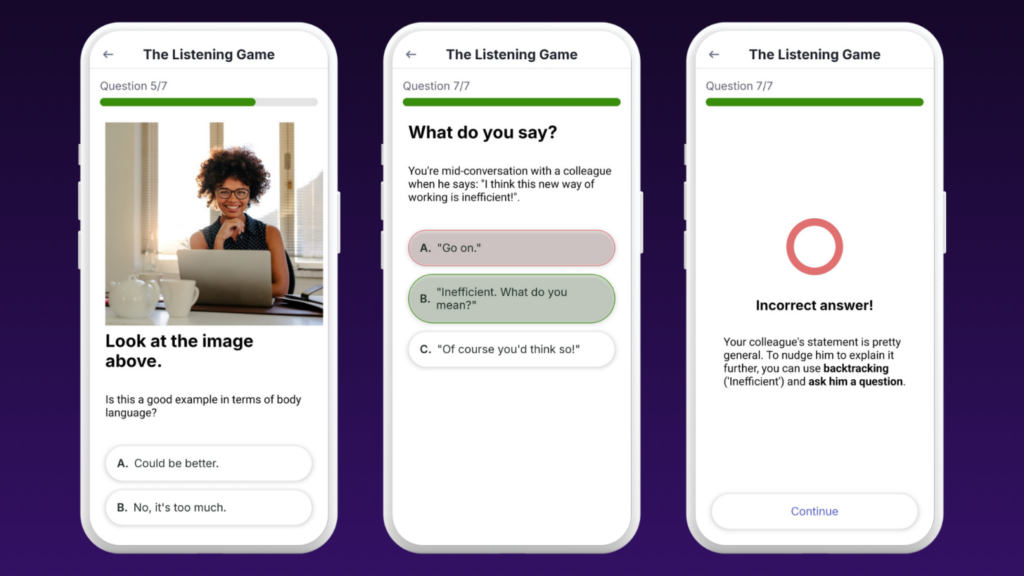
‘Exercise’ stands for practicing in a safe (learning) environment. The focus here is on converting knowledge into application. Give your learner the opportunity to try out their acquired knowledge, make mistakes, and learn from them. This is how you prepare your employees to apply it in real life.
The word ‘safe’ is there for a reason. 😉 Making mistakes is allowed; in fact, it is encouraged in this step of the learning process. Because it is precisely by experimenting that their confidence in their new skills grows, which will promote their application in practice.
👉 Tip: Create moments in your learning programs where participants can practice without direct consequences. This creates space for mistakes and the learning moments that result from them.
Apply
After the ‘Exercise’ phase comes the moment when they must apply their new knowledge and skills in practice. In the real world, there is naturally less room to make mistakes. Therefore, it is important to guide this step well. This increases not only the chance of success but also the impact on the individual and the organization. Encourage participants to practice their new skills in a specific (and relevant) situation.
Also motivate them to announce that they are going to try something new. This creates transparency and ensures that colleagues can provide feedback. This allows them to measure their progress and perhaps encourage others to get started as well (in other words, they inspire others to start their own learning cycle).
👉 Tip: Deliberately build moments into your learning program where participants can plan, execute, and evaluate their application. This way, ‘Apply’ does not become an accidental step, but a powerful part of the learning process where knowledge truly comes to life.
Repeat
This builds on the previous step in the learning process. But where ‘Apply’ is about deploying new skills in practice, ‘Repeat’ focuses on anchoring them. Repetition helps to convert conscious behavior into something that happens almost automatically (or unconsciously), and that is exactly what you want to achieve.
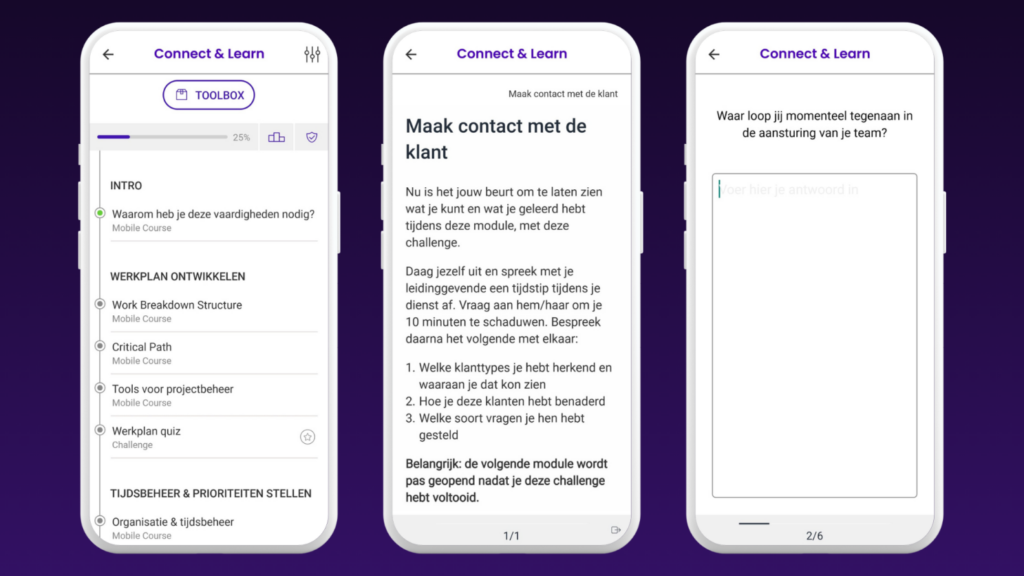
One important note: Repetition is not monotonous rehashing. Effective repetition is focused and purposeful. By practicing small, defined topics repeatedly, you strengthen the skill and increase retention. This allows you to build solid knowledge blocks that learners can easily refer back to later.
👉 Tip: Build in recurring touchpoints, both within your learning program and outside of it. Think of short assignments, check-ins with colleagues or a buddy, and practical challenges that highlight one specific aspect of the training.
By cleverly spacing repetition over time and offering it in a different way each time, you strengthen both the skill and the self-confidence of your learners. This way, knowledge is not just reproduced, but structurally anchored in daily actions.
Nurture
In this phase, the learner does not just complete their own learning trajectory; they are connected with colleagues and become a facilitator and an inspiration for others. Imagine, for example, that you want to improve your communication skills. You take an ‘Active Listening’ course and apply a learned technique. Later, you share your positive experience with the community. Your colleague sees it, gets inspired, and starts their own iLEARN trajectory. Before you know it, the entire organization is connected and growing together! 😁
- Individual level → Your colleagues see what is possible and are inspired to get started themselves.
- Team level → The effects accumulate; multiple team members develop the same skill and share their experiences and tips.
- Organizational level → A learning culture (and company culture) emerges where everyone grows together, with common goals and values.
Furthermore, this step works in both directions. Through the input and feedback of others, you can also learn from them. This ensures that the learning process becomes richer and more nuanced.
How to build ‘Nurture’ into your training programs
👉 Build in knowledge sharing. Make it easy for learners to share their experiences. Integrate knowledge sharing within your learning solution and in your way of working, for example, through monthly show-and-tell sessions or a live community feed.
👉 Encourage peer-to-peer mentoring. Bring people together who can learn from each other. For example, pair new colleagues with experienced ones. This is also a way for the mentor to refresh knowledge and strengthen their retention.
👉 Document and share best practices. Ask colleagues for their best practices, process them into various formats (e.g., videos, case studies, interviews), and share them within your organization. Remember: the best practice of one colleague can inspire another colleague to get started with their own iLEARN trajectory.
Would you like to know more about the iLearn-Framework? And how you can apply it in your organization? Please feel free to contact us!